This medicine ball exercises guide covers safe, effective moves — squats, slams, twists — and how to pick the right medicine ball weight for you.
Medicine Ball Guide: Exercises and Choosing the Right Weight
The medicine ball is one of the oldest training tools in existence — and one of the most underused in home gyms. It's simply a weighted ball, usually 2 to 30 pounds, that you lift, carry, throw, and slam. What makes it special is that it trains your body to move powerfully as one piece.
For women training at home, the medicine ball is a quiet workhorse. It takes almost no space, it's kind to apartment floors (especially the soft-shelled kind), and a single ball unlocks dozens of exercises — strength, power, and core conditioning in one inexpensive tool.
This guide covers how to choose the right weight, the essential exercises with honest technique detail, and how to build medicine ball work into your routine.
This guide contains affiliate links. If you buy through them, VÉLORA may earn a commission at no extra cost to you.
What a Medicine Ball Is (and Isn't)
A medicine ball is a weighted sphere with a slightly tacky or textured surface for grip. Two main types:
- Traditional medicine balls: firmer, often with a slight bounce. Good for wall throws and general strength work.
- Slam balls: soft, sand-filled, no bounce — designed to be thrown into the floor at full force.
Don't confuse these with stability balls (the big inflatable kind) — a medicine ball is dense, heavy, and much smaller.
Choosing the Right Weight
The most common beginner mistake is going too heavy. A ball that is too heavy slows every movement down and turns a power exercise into a grinding struggle with ugly form.
| User level | Recommended weight | Best uses | |---|---|---| | Complete beginner | 4–6 lbs | Learning technique, core work, high-rep circuits | | Active beginner | 6–8 lbs | Full-body exercises, throws, slams | | Intermediate | 8–12 lbs | Power exercises, heavier core work | | Advanced / athletic | 12–20 lbs | Explosive power training, sport-specific work |
Honest rule of thumb: start lighter than you think. If you can do 15–20 quality reps of a squat with good form, the weight is right for conditioning.
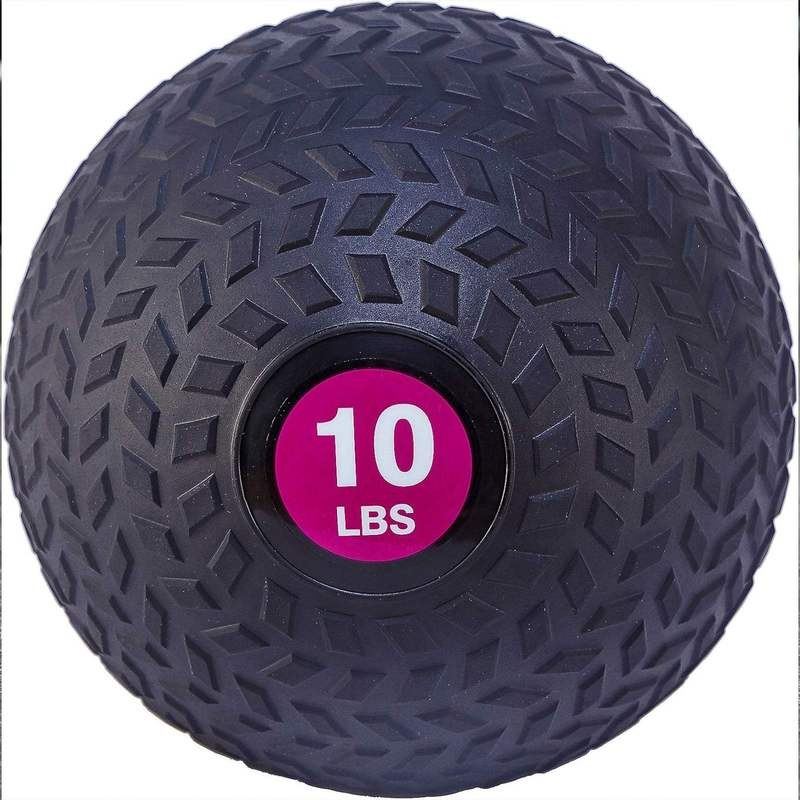
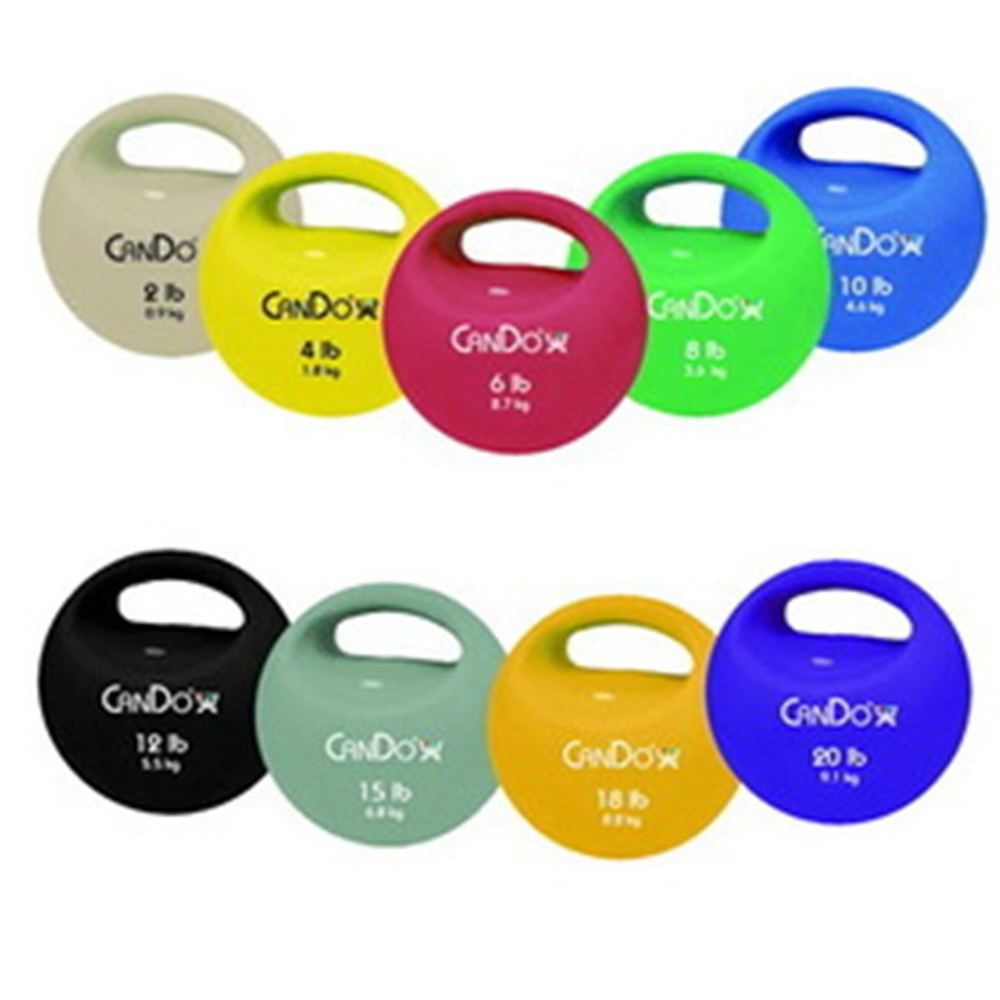
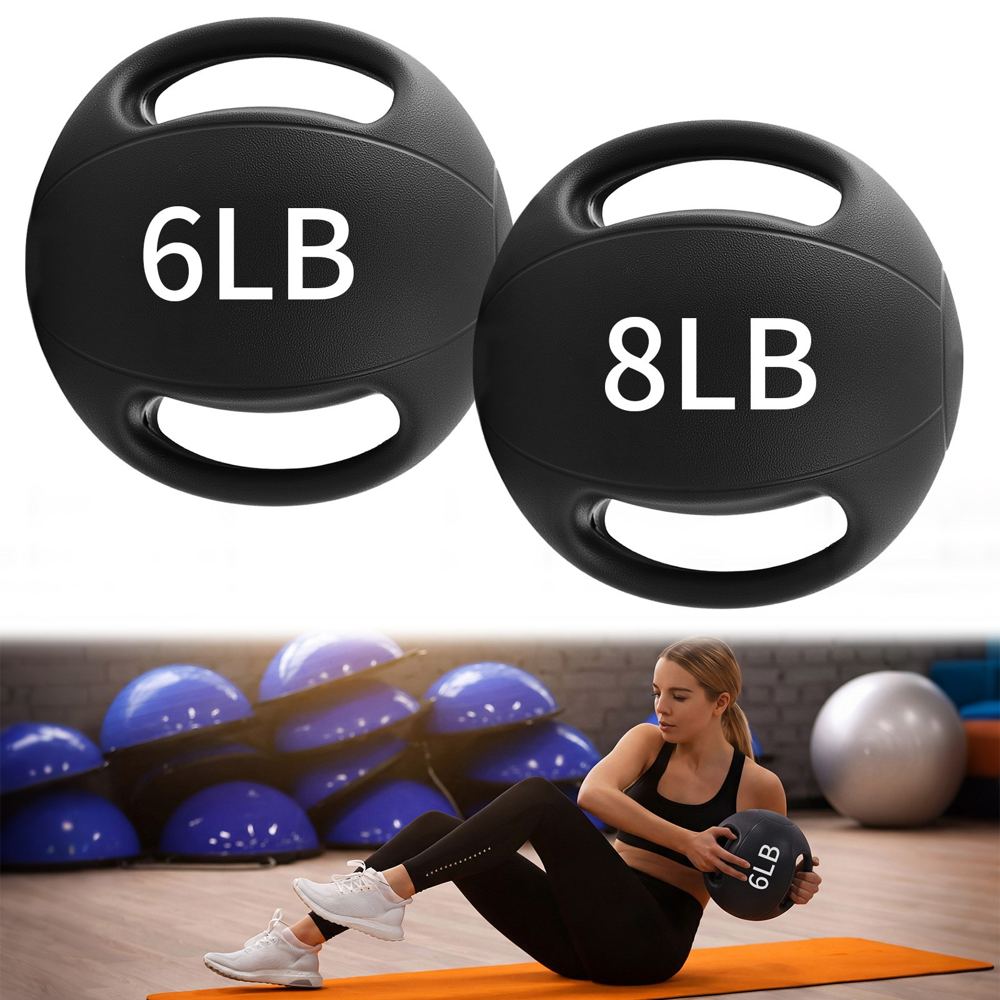
For most women, a 6–10 lb ball covers the vast majority of training. A 10-pound option like the Fitvids 10 Pound Weighted Medicine Ball in purple is a solid middle-ground choice — heavy enough for squats and carries, light enough for throws and twists. A dual-grip pair with 6 lb and 8 lb balls gives you two weights in one purchase, which is genuinely useful. And if you like handles, a 10 lb one-handle medicine ball makes the grip far more comfortable.
The Essential Exercises
Five moves that cover the ball's real strengths. Learn the squat and carry first.
1. Medicine Ball Squat
A weighted squat that also teaches you to brace your trunk properly.
Starting position: stand with feet shoulder-width apart, ball held at chest height, elbows tucked.
Technique: sit back and down into a squat while keeping the ball at your chest and your torso tall. Drive through your heels to stand, squeezing your glutes at the top. Keep your knees tracking over your toes and your weight balanced — don't let the ball pull you forward.
Breathing: inhale on the way down, exhale as you stand.
Beginner modification: reduce depth to a comfortable range; or do the squat without the ball until the pattern feels natural.
Common mistakes: letting the ball drift forward and down (keep it glued to your chest); knees caving inward; holding your breath.
How much: 2–3 sets of 10–15 reps, resting 60–90 seconds between sets.
2. Overhead Slam
The most fun you'll have with a fitness tool — a full-body explosive release.
Starting position: stand with feet about shoulder-width apart, ball held overhead with arms extended.
Technique: drive the ball down into the floor as hard as you can, hinging at the hips and bending your knees as your arms come down. Squat to pick it up and stand to reset. Every rep should be aggressive — slams are about power, not endurance. Use a slam ball (non-bouncing) for this; a bouncy ball can rebound into your face.
Breathing: sharp exhale on the slam, inhale as you reset.
Beginner modification: use a light ball (4–6 lbs) and slam from chest height instead of full overhead until you trust your shoulder mobility.
Common mistakes: using a bouncing ball; rounding the back when picking it up (hinge properly); going too heavy so the "slam" becomes a slow drop.
How much: 3–4 sets of 8–12 reps, resting 90 seconds between sets. When the explosiveness fades, stop the set.
3. Russian Twist with Ball
A classic trunk exercise that the ball makes meaningfully harder.
Starting position: sit on the floor, knees bent, feet flat. Lean back slightly so your torso forms a V with your thighs. Hold the ball at your chest.
Technique: rotate your torso to one side, bringing the ball beside your hip, then rotate to the other side. Your hips stay square and still — the rotation comes from your midsection. Move with control, and lift your feet a few inches off the floor for more challenge.
Breathing: exhale on each rotation, inhale returning to center.
Beginner modification: keep your feet on the floor and use a light ball; or do the twist without weight until you can control the rotation.
Common mistakes: rotating the arms while the torso stays frozen (move the ribcage, not just the hands); holding your breath; going so fast that form disappears.
How much: 2–3 sets of 10–16 total rotations, resting 60 seconds between sets.
Our detailed Russian twist exercise guide covers this movement's technique in even more depth.
4. Wall Ball Throw
A total-body power move: squat, stand, throw, catch, repeat.
Starting position: face a sturdy wall (or rebounder) about 2–3 feet away, ball at chest height.
Technique: squat down with the ball at your chest, then drive up explosively, extending your body and throwing the ball up at the wall. Catch it as it comes back down, absorbing the catch by dropping straight into your next squat. The squat-to-throw should be one continuous, powerful motion.
Breathing: exhale on the throw, inhale on the catch and squat.
Beginner modification: skip the throw — do a squat-to-chest-press (press the ball overhead at the top without throwing). Add the throw once your squat pattern is solid.
Common mistakes: throwing with the arms alone instead of driving from the legs; standing too close to the wall; catching with stiff, straight arms.
How much: 3–4 sets of 8–12 reps, resting 90–120 seconds between sets.
5. Medicine Ball Carry
Walking with a heavy ball — simple, humbling, and excellent for your trunk, grip, and posture.
Starting position: hold the ball at your chest (bear-hug style) or overhead with arms extended.
Technique: stand tall — ribs down, pelvis neutral — and walk steadily. Don't rush. Keep your shoulders away from your ears and your gaze forward. The ball will try to pull your posture out of shape; your job is to refuse.
Breathing: steady, continuous breathing. Never hold your breath on a carry.
Beginner modification: carry at chest height for shorter distances; work up to overhead carries and longer distances over weeks.
Common mistakes: leaning back to counterbalance the ball; shrugging the shoulders; going too heavy too soon.
How much: 3–4 walks of 30–60 seconds (or 40–60 feet), resting 60 seconds between carries.
Building a Medicine Ball Session
A balanced 25-minute session, twice a week:
- Warm up (5 minutes): 2 minutes of easy marching or jogging in place, 1 minute of arm circles and hip circles, 2 minutes of bodyweight squats and torso twists.
- Power first: overhead slams — 3 sets of 10 reps (power moves go first, when you're fresh).
- Strength: squats — 3 sets of 12; wall ball throws — 3 sets of 10.
- Core: Russian twists — 3 sets of 14 rotations.
- Finisher: carries — 3 walks of 45 seconds.
- Cool down (3 minutes): standing quad and hip-flexor stretches, cross-body shoulder stretch.
For how to organize this alongside the rest of your week, see how to structure a workout and our beginner core program.
Common Mistakes to Avoid
- Too heavy, too soon. The single most common error. Form degrades, joints take the load, and the fun disappears. Drop the weight and move well.
- Skipping the warm-up. Throws and slams are explosive — cold shoulders and backs don't like surprises.
- Bouncing balls for slams. A traditional medicine ball rebounds. Slamming one into the floor is how people get hit in the face. Use a proper slam ball for slams.
- Holding your breath. Especially on carries and heavy squats. Continuous breathing keeps blood pressure stable and lets you last the set.
- Rushing reps. Medicine ball work rewards control and power, not frantic speed. Slow down until every rep looks the same.
Safety Notes
- Inspect the ball before use — cracked shells or leaking fill mean it's done.
- Clear the area around you, especially for throws and slams. Give yourself at least 6 feet of open space in the direction of the throw.
- Slam only on floors that can take it — concrete, rubber, or outdoors. Never slam on tile or hardwood you care about.
- Stop for sharp pain in the shoulders, wrists, or back. Muscle fatigue is normal; joint pain is a stop signal.
- If you are pregnant, postpartum, or managing a shoulder, wrist, or back injury, get your provider's go-ahead before doing throws and slams.
FAQ
Q: What weight medicine ball should a woman start with?
Most women do well starting at 6–8 lbs for general training. If you've never trained with a weighted ball, a 6 lb ball teaches technique safely; move up to 8–10 lbs once you can complete full sets with good form. There's no shame in a light ball — control beats ego every time.
Q: Are medicine balls good for abs?
They're good for trunk training as part of a full-body program. Twists, slams, and carries all challenge your midsection meaningfully. But no exercise — medicine ball or otherwise — spot-reduces belly fat. The ball builds strength; overall nutrition and activity determine body composition, and results vary.
Q: Can I use a medicine ball on carpet or at home?
Yes — medicine balls are among the most apartment-friendly tools there is. Slams are the exception: do those on a mat, rubber flooring, or outdoors. Everything else (squats, twists, carries, presses) works fine on carpet in a small space.
Q: What's the difference between a medicine ball and a slam ball?
A slam ball is designed specifically for throwing into the floor — soft, sand-filled, no bounce. A traditional medicine ball is firmer and may bounce, making it better for wall throws and partner work. If slams are your main interest, buy a slam ball.
Q: How often should I train with a medicine ball?
Two to three times per week works well for most people, either as a standalone session or as part of a larger workout. Power exercises like slams and throws need 48 hours of recovery between sessions; lighter core and conditioning work can be done more often.
Conclusion
The medicine ball earns its place by making your body move as one powerful unit. Start light, learn the five essentials, and let the weight grow only when your form does. It's a simple tool, and that's exactly why it works.
