The deadlift builds total-body strength — but only with good form. Learn the beginner dumbbell Romanian deadlift: hinge, neutral spine, and safe progression.
Deadlift Form for Beginners: Technique With Light Weights
The deadlift has a reputation as the most intimidating lift in the gym — and the most rewarding. Done well, it builds your glutes, hamstrings, back, and grip in one efficient movement, and it teaches your body the hip-hinge pattern that protects your back in everyday life. Done badly, it's a fast track to a sore lower back.
Here's the secret most beginners never hear: you don't need a barbell to learn the deadlift. The dumbbell Romanian deadlift is the perfect entry point — lighter, more forgiving, and every bit as effective for learning the movement pattern. This guide walks you through the hip hinge step by step, with light weights, clear cues, and honest safety guidance. As with any training, individual results vary.
This guide contains affiliate links. If you buy through them, VÉLORA may earn a commission at no extra cost to you.
Why Beginners Should Start With Dumbbells
A barbell deadlift starts from the floor, which demands a certain amount of mobility and setup precision. Get the setup wrong with heavy weight and your back pays for it. Dumbbells remove most of that risk:
- The weight stays at your sides, close to your body — a more natural and forgiving path.
- You control the range — you stop the descent where your hamstrings tell you to, not where a barbell forces you.
- Light loads let you learn the pattern — the hip hinge — before load ever becomes the limiting factor.
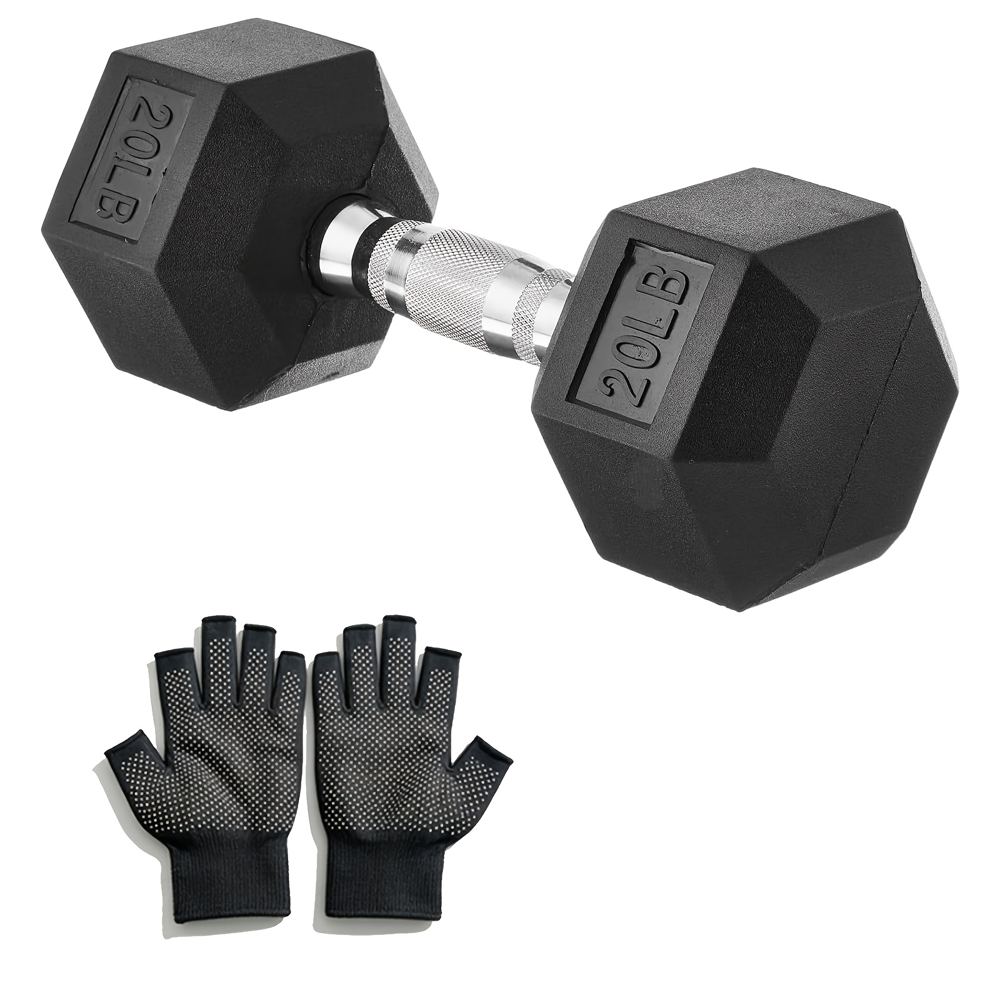
A pair of light rubber-coated hex dumbbells is ideal for learning. The hex shape keeps them from rolling, and starting light means your technique — not your ego — sets the pace.
The Hip Hinge: The Pattern Behind the Lift
Forget "lifting the weight." The deadlift is a hip hinge: your hips travel backward while your torso tips forward, with your knees bending only slightly. Your hamstrings and glutes do the work; your back stays rigid and neutral, simply transmitting force.
Learn the hinge without weight first:
- Stand tall, feet hip-width apart, soft knees.
- Place your hands on the crease where your thighs meet your hips.
- Push your hips straight back — imagine reaching your glutes toward a wall behind you — while your torso naturally tips forward.
- Keep a long, neutral spine: chest proud, chin tucked slightly, back flat.
- Stop when you feel a strong stretch in your hamstrings — for most people the torso ends up somewhere between 45 degrees and parallel to the floor.
- Drive your hips forward to stand tall, squeezing your glutes at the top.
If the pattern feels foreign, practice with a broomstick along your spine — it should touch your head, upper back, and tailbone throughout. Losing contact at the lower back means you're rounding.
Dumbbell Romanian Deadlift: Step by Step
Once the bodyweight hinge feels natural, add dumbbells:
Setup: Stand tall holding a dumbbell in each hand at your sides, palms facing your thighs. Feet hip-width apart, knees soft (unlocked but not bent deeply), chest lifted, shoulders pulled slightly back and down — this is "lat engagement," and it keeps the weights from pulling your shoulders forward.
The descent: Take a belly breath and brace your core. Hinge your hips back, letting the dumbbells slide straight down the fronts of your thighs. Keep the weights close — they should graze your legs the whole way down. Stop when your hamstrings reach their stretch limit or the dumbbells reach about mid-shin; your back must stay flat the entire time.
The lift: Drive your hips forward powerfully, squeezing your glutes to finish standing tall. Exhale as you pass the hardest part. The dumbbells travel back up the same path, close to your body.
At the top: Stand fully upright and squeeze your glutes — but don't lean back or hyperextend your spine. That's a common and pointless error; the rep ends at vertical.
Breathing and Bracing
The breathing pattern mirrors the squat:
- At the top, inhale into your belly and brace your core — imagine tightening as if expecting a gentle poke to the stomach.
- Hold the brace through the descent and the initial drive.
- Exhale as you finish standing up.
This bracing is what protects your spine under load. A braced core turns your torso into a rigid column; an unbraced core lets the lower back round, which is where injuries happen. For very light warm-up sets you can breathe naturally, but brace properly for every working set.
Lat Engagement: The Cue Everyone Skips
"Engage your lats" sounds abstract until you feel it. Try this: imagine you're squeezing an orange in each armpit, or bending the dumbbell handles (without actually bending your arms). Your shoulders should pull slightly back and down, and your upper back should feel "locked in."
Why it matters: engaged lats keep the weights close to your body and prevent your shoulders from rounding forward, which is the first domino in the chain that leads to a rounded lower back. It takes two seconds to set and transforms the lift.
Sets, Reps, and Progression With Light Weights
For learning the hinge pattern:
- Weeks 1–2: 3 sets of 10–12 reps with very light dumbbells, resting 60–90 seconds. Every rep should look identical — that's the goal, not fatigue.
- Weeks 3–4: 3–4 sets of 8–10 reps, adding a small amount of weight if your form stayed perfect last week.
- Beyond: 3–4 sets of 6–10 reps, increasing load gradually. An adjustable dumbbell with wear-resistant grips is perfect here — small jumps without buying new weights each time.
Train deadlift-pattern movements 1–2 times per week; the posterior chain recovers more slowly than you think. A 3-pair PVC dumbbell set with case is another practical option for shared households, giving you ready-made light, medium, and heavier options for progressive learning.
The progression path after dumbbell Romanian deadlifts feel automatic: deadlifts from the floor with dumbbells (deeper range), then single-leg Romanian deadlifts (balance plus unilateral strength), and only then — if you want — the barbell deadlift. There's no rule saying you ever need a barbell.
Hinge vs. Squat: Know the Difference
| | Hip hinge (deadlift) | Squat | |---|---|---| | Primary joint action | Hips travel back; knees bend slightly | Hips and knees bend together deeply | | Torso angle | More horizontal | More upright | | Main muscles | Glutes, hamstrings, back | Quads, glutes | | Key cue | "Push hips back, feel hamstrings stretch" | "Sit down between your heels" | | What it should feel like | Stretch then squeeze in the back of your legs | Effort in the front of your thighs and glutes | | Common mix-up | Squatting the hinge (too much knee bend, torso too upright) | Hinging the squat (hips shoot back, chest collapses) |
If your deadlift starts feeling like a squat — deep knee bend, upright torso, quads burning — reset and rehearse the bodyweight hinge until the pattern is clean again.
Common Beginner Mistakes
- Rounding the lower back. The number-one deadlift error. Fix: lighten the load, brace harder, stop the descent at your hamstring limit, and rehearse the broomstick drill. Filming yourself from the side is the fastest diagnostic.
- Squatting the hinge. Bending the knees deeply and dropping straight down turns it into a squat with the weight in a bad position. Fix: initiate every rep by pushing the hips back first.
- Hyperextending at the top. Leaning back past vertical does nothing for your glutes and compresses your lower back. Fix: finish tall and squeeze — vertical is the end of the rep.
- Letting the weights drift forward. Dumbbells swinging away from your legs multiplies the load on your lower back. Fix: engage lats, keep the weights grazing your thighs and shins.
- Jerking the weight up. Yanking from a dead stop with a rounded back is how injuries happen. Fix: take the slack out first — brace, then drive smoothly.
For no-equipment alternatives and variety, our deadlift alternatives at home guide has you covered. To place deadlifts into a balanced week, see how to structure a workout and the beginner strength training program.
Safety Notes
- Stop and seek guidance if you feel sharp, shooting, or radiating pain — especially pain running down a leg. Muscle effort and hamstring stretch are normal; sharp pain is not.
- Never train through a "twinge" in your lower back hoping it resolves mid-set. End the set, reassess your form with lighter weight or bodyweight, and if pain persists, see a qualified professional.
- If you have a history of disc issues, sciatica, or back surgery, get clearance and ideally a form check from a qualified trainer or physiotherapist before loading hinges.
- Warm up 5–10 minutes before deadlifting — leg swings, bodyweight hinges, and glute bridges prepare the exact tissues you're about to load.
FAQ
Q: Is the deadlift safe for beginners?
With light weights and proper hinge technique, yes — it's one of the most useful movements a beginner can learn, because the hip hinge protects your back in daily life. The risk comes from heavy loads with poor form, which is exactly why beginners should start with light dumbbell Romanian deadlifts and master the pattern first.
Q: What's the difference between a Romanian deadlift and a regular deadlift?
A Romanian deadlift starts from standing and hinges down to about mid-shin, emphasizing the hamstrings and the hinge pattern. A conventional deadlift starts from the floor each rep. For beginners, the Romanian version is the better teacher — less setup complexity, constant tension, and a more forgiving learning curve.
Q: Should I feel deadlifts in my lower back?
You should feel your back working — the spinal erectors stabilize the load — but the dominant sensation should be hamstring stretch on the way down and glute squeeze on the way up. If your lower back is the main thing you feel, or it aches afterward, your form needs attention: check for rounding, bracing, and weights drifting forward.
Q: How heavy should a beginner deadlift?
Light enough that every rep looks clean — for most beginners, that's dumbbells in the 10–25 lb per-hand range to start. The right weight is the heaviest load you can lift with a flat back, braced core, and smooth tempo. Add weight in small steps only when form is consistent across all sets.
Q: How often should beginners do deadlifts?
Once or twice per week is plenty. The hinge pattern loads the posterior chain heavily, and those muscles need recovery time. Pair deadlift days with upper-body or lighter work on other days rather than stacking heavy lower-body sessions back to back.
Q: Do I need a belt for deadlifts as a beginner?
No. Beginners should learn to brace their own core first — a belt is a tool for experienced lifters moving heavy loads, not a substitute for learning proper bracing. Master the unbelted hinge with light weights; revisit the question much later if you ever move to heavy barbell work.
Conclusion
The beginner deadlift is really a lesson in one pattern: the hip hinge. Learn it with light dumbbells, keep your spine neutral, brace your core, engage your lats, and progress the load only as fast as your form allows. Be patient — a clean hinge learned slowly will serve you for decades, in the gym and in everyday life. Stop at any sign of sharp pain, and don't hesitate to get a professional form check. Done right, the deadlift isn't the scary lift. It's the one that makes everything else easier.