Workout splits explained: full-body, upper/lower and push/pull/legs compared by days, pros and cons — plus which split fits your schedule and level.
Workout Splits Explained: Full-Body vs Upper/Lower vs Push/Pull/Legs
A workout split is simply how you divide your training across the week — which muscles you train on which days. It sounds like an advanced topic, but it is really a scheduling question: given the days you can actually train, how do you organize the work so every major muscle group gets trained and recovered? This guide compares the three most proven splits — full-body, upper/lower, and push/pull/legs — honestly: the days each needs, what each does well, where each falls short, and which one fits your schedule and experience level.
There is no universally best split. The best split is the one you can repeat for months. A theoretically perfect five-day program you follow for two weeks loses to a simple three-day program you follow for a year. Results vary, and no split guarantees a particular outcome or timeline — consistency does the real work here.
This guide contains affiliate links. If you buy through them, VÉLORA may earn a commission at no extra cost to you.
What a Split Is (and Why It Matters)
Every effective strength program answers two questions: which muscles get trained, and when do they rest. Muscles need roughly 48 hours to recover after a solid session, so you cannot productively hammer the same muscles every day. A split organizes this. It decides whether you train everything in one session or divide the body across the week, and it sets how often each muscle gets worked — its training frequency.
Frequency matters because muscles respond to being trained about 2–3 times per week. A split that hits each muscle once a week can work for very advanced lifters doing huge volumes, but for most people, twice a week is the sweet spot. Keep that in mind as you read the comparisons below.
Full-Body Split: Train Everything, 2–3 Days a Week
In a full-body split, each session trains all the major muscle groups: legs, back, chest, shoulders, and core. You might do 5–7 exercises per session covering squats, hinges, pushes, pulls, and carries, and you repeat this 2–3 times a week on non-consecutive days.
Why it suits beginners so well: every session practices the fundamental movement patterns, so your technique improves fast. Each muscle gets trained 2–3 times a week with moderate volume, which is ideal for the rapid early gains beginners make. And if life eats a workout, you have not missed an entire body part for the week — you just did slightly less of everything.
The honest downsides: sessions can feel long because you are covering the whole body, and as you get stronger and need more volume per muscle, a full-body session can stretch past an hour. Advanced lifters often find they cannot fit enough quality work for every muscle into one session.
Sample Full-Body Week (3 days)
- Monday: Goblet squat, dumbbell floor press, one-arm row, Romanian deadlift, plank — 2–3 sets each, 8–12 reps.
- Wednesday: Same pattern with slight variations (e.g., split squat instead of goblet squat, incline press instead of floor press).
- Friday: Repeat Monday's session, aiming for one more rep or slightly more weight than last time.
If this is your first structured program, start here. Our beginner strength training program is built exactly this way, and our guide on how to start strength training as a woman explains the foundations it assumes.
Upper/Lower Split: 4 Days, Alternating Halves
An upper/lower split divides the body in two. Upper days train chest, back, shoulders, and arms; lower days train quads, glutes, hamstrings, and calves, plus some core. You train 4 days a week, alternating: upper, lower, rest, upper, lower, rest, rest — or a similar rhythm.
Why people love it: each session is focused, so you can do more quality work per muscle than in a full-body session. Each half still gets trained twice a week, keeping frequency high. Sessions are typically 45–60 minutes, which fits busy schedules.
The honest downsides: it demands four days. If you miss a day, the balance shifts — two missed lower days in a row means legs went a week without direct work. And single sessions are harder than full-body ones, because you are concentrating all the week's work for those muscles into one day.
Sample Upper/Lower Week (4 days)
- Monday — Upper: Dumbbell bench press, one-arm row, overhead press, lat pulldown or band pull-apart, bicep curl — 3 sets each.
- Tuesday — Lower: Goblet squat or split squat, Romanian deadlift, glute bridge, calf raise, dead bug — 3 sets each.
- Thursday — Upper: Incline press, chest-supported row, lateral raise, push-up, hammer curl — 3 sets each.
- Friday — Lower: Deadlift or hip hinge, walking lunge, hip thrust, leg curl with band, side plank — 3 sets each.
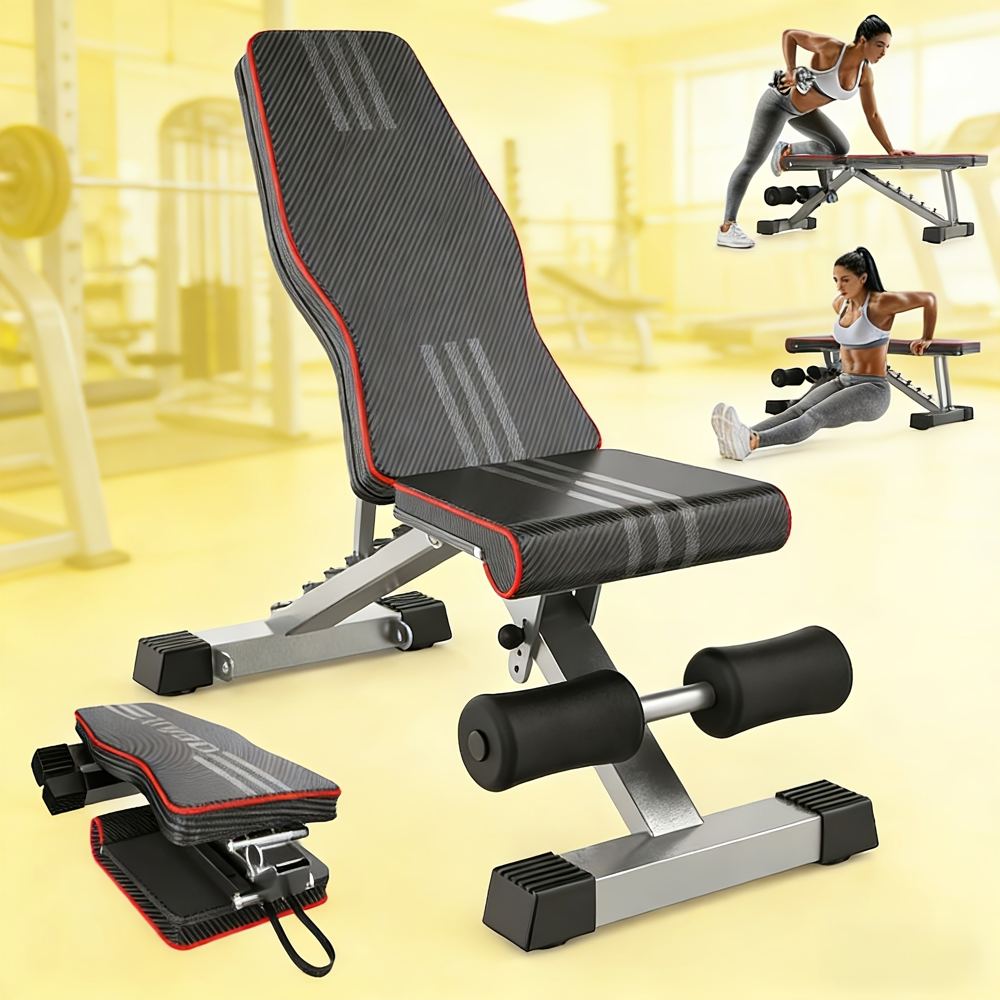
A sturdy adjustable bench makes upper/lower training far more versatile at home — the Temu Adjustable Weight Bench folds away between sessions if space is tight.
Push/Pull/Legs: 5–6 Days for Dedicated Lifters
Push/pull/legs divides training by movement pattern. Push days work the chest, shoulders, and triceps (bench press, overhead press). Pull days work the back and biceps (rows, pull-ups, curls). Leg days work quads, glutes, hamstrings, and calves. The classic version runs 6 days — push, pull, legs, push, pull, legs — though a 5-day version drops one repeat.
Why dedicated lifters choose it: each muscle group gets a fully focused session with high volume, and because push and pull muscles are different, you can train on consecutive days without overlap. It is excellent for building balanced strength once you have the base to handle the volume.
The honest downsides: five to six days is a serious time commitment, and the total weekly volume is high — recovery, sleep, and food all need to be genuinely good or you will run yourself down. For beginners, it is usually overkill: you do not yet need that much volume to progress, and the complexity adds failure points to your schedule.
Sample Push/Pull/Legs Week (5 days)
- Monday — Push: Dumbbell bench press, overhead press, incline press, lateral raise, tricep extension.
- Tuesday — Pull: One-arm row, bent-over row, band pull-apart, bicep curl, face pull with band.
- Wednesday — Legs: Goblet squat, Romanian deadlift, lunge, glute bridge, calf raise.
- Thursday — Rest.
- Friday — Push (lighter): Push-up, overhead press, chest fly with dumbbells, tricep kickback.
- Saturday — Pull + legs (lighter): Row, deadlift, split squat, curl.
The Three Splits Compared
| Split | Days per week | Pros | Cons | Best for | | --- | --- | --- | --- | --- | | Full-body | 2–3 | Highest frequency per muscle; technique practice; missed day hurts least; shortest weekly commitment | Long individual sessions; limited volume per muscle as you advance | Beginners and anyone training 3 or fewer days | | Upper/lower | 4 | Focused sessions; each muscle trained 2×/week; good volume balance | Needs 4 days; missed days unbalance the week; harder single sessions | Intermediates with 4 reliable training days | | Push/pull/legs | 5–6 | Maximum focus and volume per muscle; train consecutive days safely | Huge time demand; high recovery needs; overkill for beginners | Advanced lifters with 5+ days and solid recovery |
Frequency and Volume Guidance
Whatever split you choose, these ranges keep you in productive territory:
- Frequency: train each major muscle group 2–3 times per week. Once a week is the minimum that maintains; twice is where most growth in strength happens for non-advanced lifters.
- Sets per muscle per week: beginners typically progress well on 6–10 hard sets per muscle per week; intermediates on 10–15. Start at the low end — you can always add.
- Reps: 6–12 reps per set covers most strength and muscle-building goals; 12–20 works well for smaller muscles and beginners learning control.
- Rest between sets: 60–120 seconds for most dumbbell work; longer (2–3 minutes) for heavy compound lifts if you do them.
When to Switch Splits
Start with full-body. Consider moving to upper/lower when: you have been training consistently for 4–6 months, your full-body sessions regularly exceed 75 minutes because you need more sets per muscle, and you genuinely have four days a week to train. Consider push/pull/legs when: you have a year or more of consistent training, you recover well (sleeping enough, eating adequately), and you want — and can sustain — five or more days.
Switch because your recovery and schedule support it, not because a split sounds more advanced.
For a men's perspective on structuring the week, see our beginner workout plan for men, which uses the same full-body-first logic.
Common Mistakes
- Choosing by ambition instead of schedule. A 6-day split on a 3-day life fails by week three. Be honest about the days you will actually train.
- Training the same muscles daily. Enthusiasm is good; hammering chest every day is not. Respect the roughly 48-hour recovery window.
- Changing splits every month. Each split needs 8–12 weeks of consistent use before you can judge it. Program-hopping is the enemy of progress.
- Ignoring the weak half. Upper/lower splitters who "forget" leg day, push/pull/legs lifters who skip pull day — the split only works if you run all of it.
FAQ
Q: Can I build muscle with a 3-day full-body split?
Yes. For beginners and early intermediates, 3 full-body days provide each muscle with 2–3 weekly sessions at solid volume — exactly the stimulus most people need to get stronger. Many lifters make their best progress of their training life on this setup. Advanced lifters may eventually need more volume per muscle than fits in one session, which is when a 4-day split earns its place.
Q: Is it okay to train 2 days a week?
Absolutely — two full-body sessions a week still train every muscle twice weekly, which maintains and slowly builds strength. It will not maximize progress, but it beats an ambitious plan you abandon. If two days is your honest reality, run two full-body days and progress them patiently.
Q: Should men and women use different splits?
No. The splits work the same way regardless of sex; muscles respond to training frequency and progressive overload, not to gendered programming. Exercise selection can reflect individual goals — many women in our audience prioritize glutes and legs, which any split accommodates — but the split structure itself needs no modification.
Q: How long should I stay on one split before switching?
Give any split at least 8–12 weeks of consistent training before judging it. Strength adaptations take weeks to show in your log. Switching monthly guarantees you never find out whether the program worked. Change splits when your schedule, recovery, or experience level genuinely changes — not out of boredom.
Q: Can I combine splits, like upper/lower on some weeks?
It is better to pick one split and run it cleanly. Mixing structures week to week makes frequency uneven — some muscles get trained once, others three times — and your log becomes hard to interpret. If your schedule varies, choose the split that fits your minimum reliable days, and treat extra days as bonus full-body sessions.
Conclusion
Full-body for three days, upper/lower for four, push/pull/legs for five or six — each split is simply an honest answer to how many days you can train. Beginners should start with full-body and stay there until sessions genuinely outgrow the format, then step up only as far as their schedule and recovery support. Pick the split that fits your real week, run it for at least two to three months, and let consistency do what no perfect program on paper can do alone.