Curious about HIIT? A beginner-safe introduction: what intervals actually are, work-to-rest ratios that work, a 12-minute starter session, and safety rules.
HIIT for Beginners: A Safe Introduction to Interval Training
HIIT — high-intensity interval training — has a reputation for being the workout of the extremely fit: burpee marathons, gasping for air, collapsing on the floor. That reputation is misleading. At its core, HIIT is simply alternating short bursts of effort with recovery periods. Nothing about that formula requires you to be an athlete — and a beginner version looks very different from what you see on social media.
This guide demystifies intervals: what they actually are, the work-to-rest ratios that work for beginners, a complete 12-minute starter session, low-impact alternatives, and the safety rules that keep your first experiences positive.
This guide contains affiliate links. If you buy through them, VÉLORA may earn a commission at no extra cost to you.
What HIIT Actually Is (and Isn't)
HIIT means working hard for a short period, then recovering, then repeating. A "work" interval might be 20–30 seconds of marching quickly or doing bodyweight squats; a "rest" interval might be 30–60 seconds of gentle marching or standing still. That alternation is the entire method.
What HIIT is not:
- Not a specific workout. It is a format — you can apply intervals to almost any exercise.
- Not necessarily jumping or pounding. Low-impact intervals (step-touches, marches, bike sprints) are fully legitimate HIIT.
- Not about going until you feel sick. If you cannot recover enough during the rest interval to go again, the work interval was too intense for today.
For beginners, think of it as "energetic intervals" rather than "maximum-intensity intervals." The structure is what matters; the intensity scales to you.
Why Beginners Can Benefit From Intervals
Interval formats are genuinely beginner-friendly for a few reasons:
- They are time-efficient. Meaningful sessions take 10–20 minutes, which is easier to fit into a busy week.
- Built-in recovery. The rest intervals are part of the design, not a sign of weakness — they let you accumulate more quality effort than one continuous hard effort would.
- Self-scaling. You control the pace. Your "hard" is relative to your fitness today, not to anyone else's.
- Mentally manageable. Knowing a hard effort lasts only 20–30 seconds makes it far easier to start than facing 20 unbroken minutes.
Like all exercise, results vary from person to person, and no workout format guarantees specific outcomes. But as a way to build cardiovascular fitness in small doses, intervals are hard to beat.
Beginner Work-to-Rest Ratios That Work
The ratio of work to rest is the main dial you turn. Beginners should start with more rest than work:
- 1:2 ratio (start here): 20 seconds of work, 40 seconds of rest. You should feel mostly recovered before each work interval.
- 1:1 ratio (progress to): 30 seconds of work, 30 seconds of rest. A solid middle ground after a few weeks.
- 2:1 ratio (advanced): 40 seconds of work, 20 seconds of rest. Only once 1:1 feels comfortable.
A practical rule: you should be able to hold a short conversation during the rest interval. If you are still gasping when the next work interval starts, extend the rest — there is no prize for rushing it.
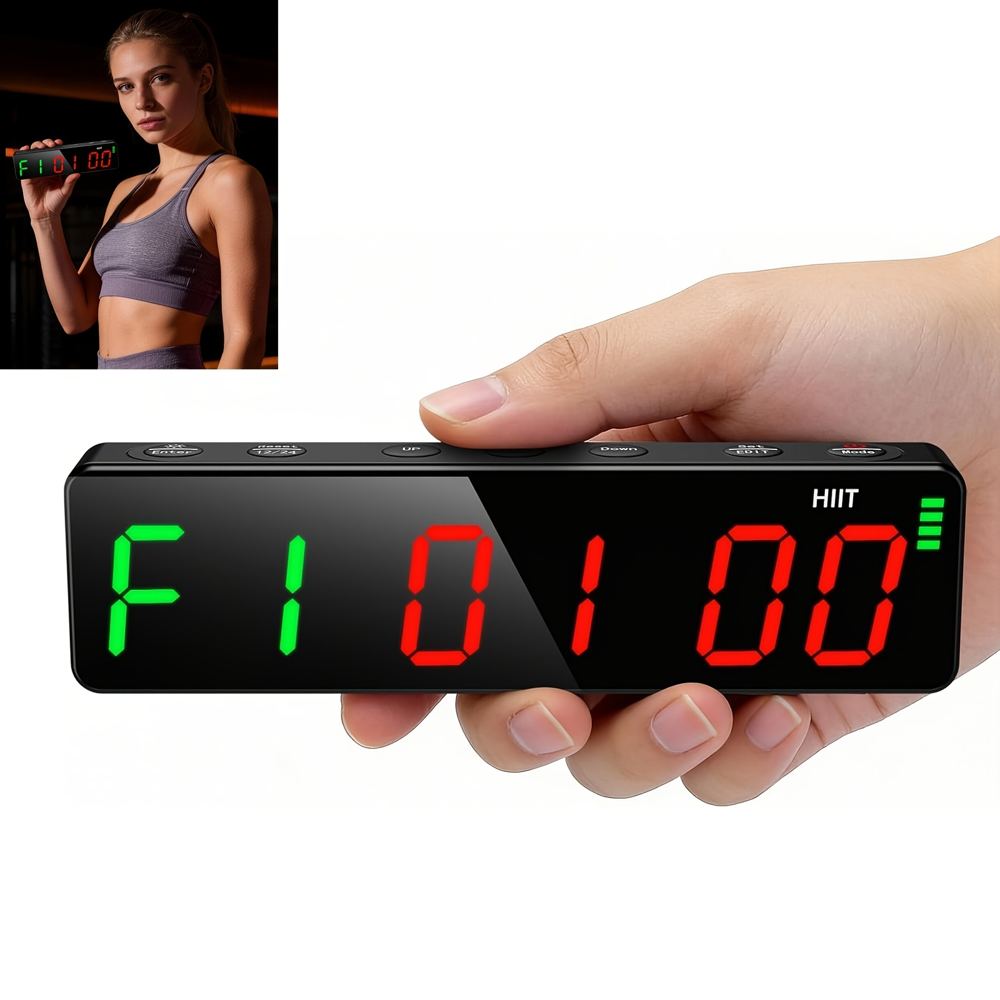
An interval timer makes this effortless: set your work and rest periods once, and it beeps you through the whole session.
Your First 12-Minute HIIT Session
Warm up first (3 minutes): march in place for 60 seconds, do 10 arm circles each direction, 10 leg swings per leg, and 10 easy bodyweight squats. Never skip this — cold muscles and intervals do not mix.
Main session — 20 seconds work / 40 seconds rest, 8 rounds (8 minutes):
- March in place, knees high — lift knees toward hip height at a brisk pace
- Bodyweight squat — feet shoulder-width, sit back and down, chest up; only as deep as feels good
- Step-touch side to side — step right, tap left foot in, step left, tap right; swing arms naturally
- Incline push-up (hands on a sturdy chair or wall) — body straight from head to heels
- Standing knee-to-elbow — lift right knee and bring left elbow toward it, alternate sides
- Glute bridge — lying on your back, feet flat, lift hips until knees-to-shoulders form a line
- Step-touch side to side — repeat round 3, slightly brisker if you feel good
- March in place, knees high — finish strong at whatever pace feels right
Cool down (2–3 minutes): walk slowly for a minute, then stretch quads, hamstrings, calves, and chest — 20–30 seconds each.
Progressing Safely Over 4 Weeks
Progression means changing one variable at a time:
- Weeks 1–2: 20s work / 40s rest, 6–8 rounds, twice a week. Master the movements.
- Weeks 3–4: 20s work / 30s rest, 8–10 rounds, or add a third weekly session. Slightly brisker work intervals.
- Week 5+: Try 30s work / 30s rest with the same exercises, or swap in slightly harder moves (regular push-ups, squat to a chair and stand).
If a progression week feels rough, repeat the previous week. Plateaus and off weeks are normal — fitness is built over months, not sessions.
Low-Impact HIIT Alternatives
If jumping bothers your joints, your pelvic floor, or your downstairs neighbors, these swaps keep the interval format fully intact:
- Burpees → walk-out to plank and back (no jump, no push-up)
- Jump squats → bodyweight squats at a brisk tempo
- Mountain climbers → slow mountain climbers or standing knee drives
- Jumping jacks → step-touch jacks (step side to side, arms overhead)
- High knees → brisk marching in place
Low-impact intervals still raise your heart rate and build fitness — the "low-impact" label describes joint stress, not effort level. Our low-impact workouts guide has more joint-friendly options.

Safety Rules and Who Should Check First
Intervals are safe for most healthy beginners when started gently — but "most" is doing a lot of work in that sentence. Follow these rules:
- Warm up and cool down every time. Non-negotiable with intervals.
- Stop rules — pause or end the session if you feel: chest pain or pressure, unusual shortness of breath that does not ease with rest, dizziness or lightheadedness, nausea, or sharp joint pain. Muscle burn and heavy breathing are normal; pain, dizziness, and chest symptoms are not. This is guidance, not fearmongering — these signals simply mean "stop and rest."
- If you are managing a diagnosed condition — heart disease, high blood pressure, diabetes, asthma, a joint or pelvic-floor condition, or you are pregnant or recently postpartum — check with your clinician before starting interval training. Bring them this article if it helps the conversation.
- Start at 1–2 sessions per week. Intervals are more demanding than they look; your body needs recovery days between sessions.
- Hydrate and eat reasonably beforehand. A light snack 1–2 hours before is plenty; training fasted and hard is a recipe for feeling awful.
- Respect fatigue. Intervals on a day when you are exhausted, ill, or sleep-deprived usually do more harm than good.
Common Beginner Mistakes
- Starting with advanced ratios. The 40-on/20-off format you saw online is for conditioned athletes. Your 20-on/40-off version is the correct beginner dose.
- Choosing exercises you cannot do well. Intervals amplify bad form — pick moves you already perform cleanly, then add intensity.
- Doing HIIT every day. More is not better; 2–3 sessions per week with rest or easy days between is the sweet spot.
- Holding your breath. Exhale on the effort, inhale on the recovery. Breath-holding spikes blood pressure and exhausts you faster.
- Comparing your round 1 to someone else's round 100. Everyone's "hard" is personal. Run your own session.
For more steady-state options to balance your week, see our cardio exercises at home guide.
Frequently Asked Questions
How often should a beginner do HIIT?
Start with 1–2 sessions per week on non-consecutive days, with easy activity or rest between. After 3–4 consistent weeks, you can add a third session. Daily HIIT is too much for almost everyone — recovery is when adaptation happens.
Is 12 minutes really enough to be useful?
For a beginner, absolutely. Twelve honest minutes of intervals provide a genuine cardiovascular stimulus, and a session you actually do beats the 45-minute session you skip. As your fitness builds, you can extend sessions to 15–20 minutes — but short sessions remain valid indefinitely.
Can I do HIIT if I have bad knees?
Often yes, with low-impact modifications: no jumping, no deep lunges, no high-impact plyometrics. Step-touches, marches, glute bridges, rows, and cycling intervals are all knee-friendly. If you have a diagnosed knee condition, check with your clinician or physiotherapist first, and stop if you feel sharp pain.
Will HIIT burn belly fat specifically?
No workout can target fat loss from one area — spot reduction is a myth, and where your body loses fat first is largely genetic. HIIT burns meaningful energy in a short time and helps preserve muscle, which supports overall fat loss when combined with sensible nutrition and sleep. Expect gradual, whole-body change, not targeted results.
Should I eat before a HIIT session?
A light snack 1–2 hours beforehand — a banana, toast, or yogurt — works well for most people. Training completely fasted can leave you lightheaded during intervals, and a heavy meal right before will sit uncomfortably. Hydrate with water before, during, and after.
What is the difference between HIIT and regular cardio?
HIIT alternates hard efforts with recovery in a short session (typically 10–25 minutes); regular or steady-state cardio maintains a moderate, sustainable effort for longer (20–60 minutes). Both build cardiovascular fitness. Many people get the best results mixing the two across the week — intervals twice weekly plus a longer easy walk or cycle.
Conclusion
HIIT is not a punishment reserved for the already-fit — it is a flexible format that meets you exactly where you are. Start with 20 seconds of work and 40 seconds of rest, choose moves you do well, keep it low-impact if your joints prefer it, and progress one variable at a time. Two short sessions a week, done consistently, will build real fitness over the coming months.
Check in with your clinician first if you are managing a health condition, respect the stop signals, and remember that your "hard" is yours alone. Intervals are a tool for your life — not a test you have to pass.