New to the gym? Follow this session-by-session beginner routine for your first month: exact exercises, rep ranges, warm-ups, and rules that keep you safe and progressing.
Beginner Gym Routine: Your First Month, Session by Session
Walking into a gym for the first time is intimidating for almost everyone — the machines look complicated, the regulars seem to know secret rules, and every corner holds something you have never touched. Here is the truth nobody tells beginners: most of those regulars felt exactly the same way.
This guide removes the guesswork. It gives you a session-by-session plan for your first month: which exercises to do, how many sets and reps, how to warm up, when to add weight, and the unwritten gym etiquette that makes you feel like you belong. Three sessions a week, full-body every time, roughly 45–60 minutes each including warm-up.
This guide contains affiliate links. If you buy through them, VÉLORA may earn a commission at no extra cost to you.
The First-Month Philosophy
Beginners do not need complexity — they need repetition. Your first month has three goals, in this order:
- Learn the movements safely. Form first, weight second, always.
- Build the habit. Three sessions a week, same days, like appointments.
- Add a little weight regularly. Small, steady increases beat dramatic jumps.
Every session is full-body, so each muscle gets trained three times a week — the ideal beginner frequency. Seven foundational moves, done well and progressed slowly, build more strength than any complicated split.
Results vary, and month-one gains come mostly from your nervous system learning the movements — real progress, even before muscles visibly change. Our guide to starting strength training for women covers the deeper why.
Machines vs. Free Weights: What Beginners Should Know
You will face this choice on day one. Here is an honest comparison:
| Factor | Machines | Free Weights (Dumbbells/Barbells) | |---|---|---| | Learning curve | Easiest — the machine guides the path | Steeper — you control the path yourself | | Safety for beginners | Built-in stability; hard to do dangerously wrong | Needs good form; start light and learn | | Muscle activation | Good for targeted muscles | Higher — stabilizer muscles work harder | | Real-world strength | Decent | Better carries over to daily life | | Progression | Simple pin or plate changes | Simple plate changes once form is solid | | Availability | Often occupied at peak hours | Dumbbells usually available |
The beginner verdict: use both. Start your first two weeks mostly on machines to learn what each muscle is supposed to feel like, then gradually shift the same movements to dumbbells and barbells. There is no prize for being "hardcore" early — there is only the prize of still training in month three, injury-free.
Your Session Structure (Every Time)
Every session follows the same skeleton:
- Warm-up (8–10 minutes): 5 minutes of easy cardio (treadmill walk, bike, or rower), then one light set of each of the day's first two exercises with very light weight to rehearse the movement.
- Main work (35–45 minutes): the exercises below, resting 60–90 seconds between sets (2–3 minutes before heavy compound sets once weights get serious).
- Cool-down (5 minutes): easy walking plus gentle stretches for the muscles you trained.
Learn this rhythm once and every future program becomes easier to follow.
The Exercises: Your First-Month Lineup
Do all seven every session, in this order. Rest 60–90 seconds between sets.
1. Goblet Squat (legs, glutes)
Hold one dumbbell vertically at your chest, elbows tucked, feet shoulder-width apart. Sit back and down with your chest up and knees tracking over your toes, then drive through your heels to stand. 3 sets of 8–12 reps. Start with the lightest dumbbell that feels like work; in weeks 3–4, try an empty-bar back squat if your form is solid.
2. Dumbbell Bench Press (chest, shoulders, triceps)
Lie on a flat bench, a dumbbell in each hand at chest level, feet flat on the floor. Press up until your arms are straight but not locked, then lower slowly until you feel a chest stretch, shoulder blades pinched lightly together. 3 sets of 8–12 reps. An adjustable bench — like the Multi-Angle Adjustable Weight Bench — lets you try a slight incline later, which many women find kinder on the shoulders.
3. Seated Cable Row or Machine Row (back, biceps)
Sit tall, chest up, and pull the handle toward your lower ribs, squeezing your shoulder blades together. Extend your arms fully between reps. 3 sets of 10–15 reps. The antidote to desk posture — treat it as non-negotiable.
4. Romanian Deadlift with Dumbbells (hamstrings, glutes, back)
Stand holding dumbbells in front of your thighs. With soft knees and a flat back, hinge your hips back, sliding the weights down your legs until you feel a strong hamstring stretch (usually mid-shin). Drive your hips forward to stand, squeezing your glutes. 3 sets of 8–12 reps. This is a hip hinge, not a squat — master it light; it is the most technical move in the plan.
5. Lat Pulldown or Assisted Pull-Up (back, biceps)
Grip slightly wider than shoulders and pull the bar to your upper chest, leaning back just slightly. Control the return — no slamming the stack. 3 sets of 8–12 reps. If your gym has an assisted pull-up machine, alternate it in; few things build upper-body confidence like real pull-up reps.
6. Standing Dumbbell Shoulder Press (shoulders, triceps)
Hold dumbbells at shoulder height, palms facing each other. Press overhead with ribs down (no leaning back), then lower with control. 2–3 sets of 8–12 reps. Start lighter than you think — shoulders fatigue fast.
7. Plank (core)
Forearms on the floor, body in a straight line, 2–3 holds of 20–40 seconds. Breathe steadily. End the session here — a tired core still braces fine for a static hold, and it is good practice for the bracing that protects your spine on the big lifts.
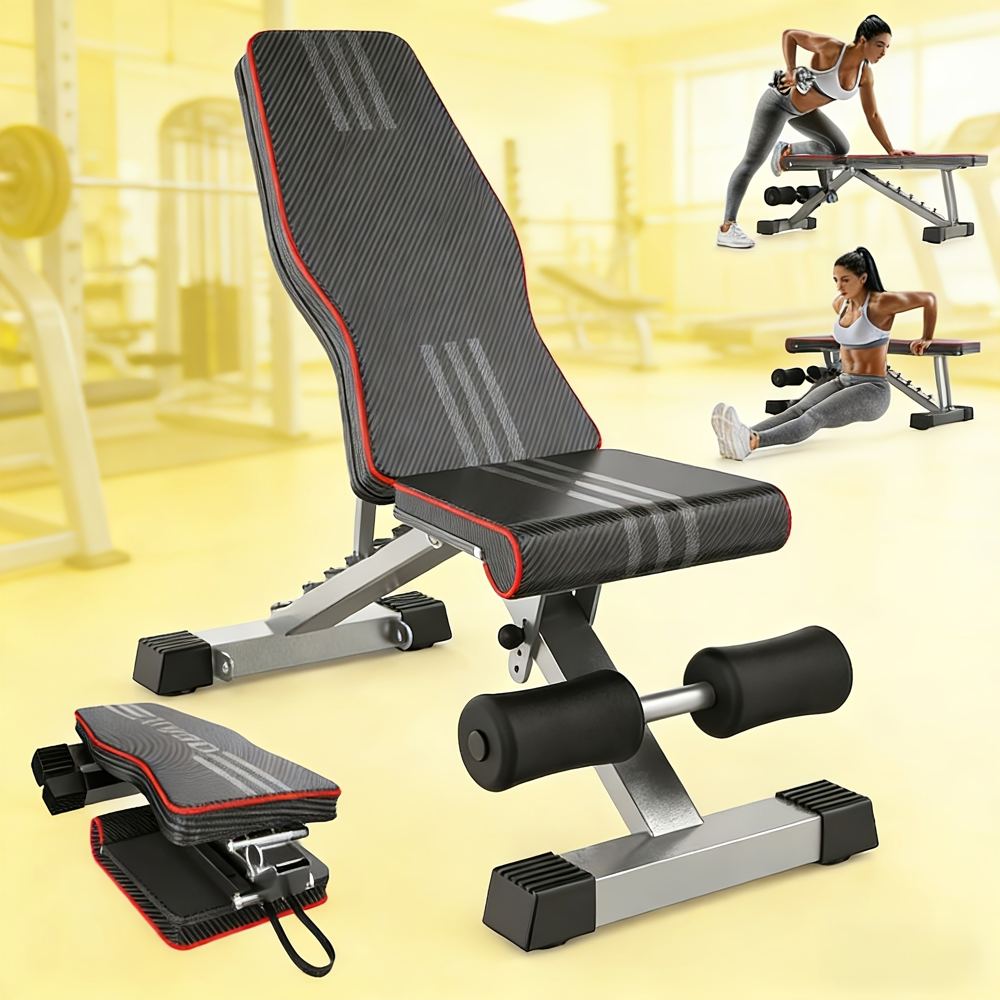
A good bench is the most versatile piece of equipment you will use this month — flat pressing, incline work, supported rows, step-ups, and Bulgarian split squats all start from the same bench.
Week-by-Week: Your First Month
Week 1 — Learn. Use very light weights. Film one set of each exercise (side angle) and compare against tutorial videos. Your only goal: clean movement patterns. Expect some soreness 24–48 hours after sessions; it is normal and fades as you adapt.
Week 2 — Repeat. Same weights or a tiny increase. Focus on consistency of form across all sets, not just the first one. By the end of this week the movements should feel familiar rather than foreign.
Week 3 — Add. Increase each exercise by the smallest available jump (usually 2.5–5 lbs / 1–2.5 kg) if you completed all sets and reps with good form last week. That is the core progression rule: all sets and reps with clean form → add the smallest possible weight next session.
Week 4 — Own it. You should now move through the session confidently, know where everything is, and be handling meaningfully more weight than week one. Deload slightly in the last session (drop weights ~10%) to let your body absorb the month, then start month two with a real program — a simple upper/lower or push/pull/legs split works well next.
Gym Etiquette: The Unwritten Rules
- Wipe down equipment after use. Every gym provides spray and towels — use them.
- Re-rack your weights. Leave every station as you found it. This one rule earns you more respect than any lift.
- Do not hog equipment during rest periods. If someone asks to "work in" (alternate sets with you), say yes — it is normal and polite.
- Keep rest areas clear. Do not camp on a bench scrolling your phone between sets while others wait.
- Ask staff for help. Trainers on the floor will gladly show you machine adjustments — they are paid to help.
- Headphones in, ego out. Nobody is watching you as much as you fear. Everyone is focused on their own workout.
Common Beginner Mistakes
- Adding weight before form is ready. The weight will still be there next week. Your joints will thank you for patience.
- Skipping the warm-up. Ten minutes of prep prevents months of rehab.
- Copying advanced lifters. The person doing exotic exercises has years of base strength. Your program is supposed to look boring — boring works.
- Training through sharp pain. Muscle burn is fine; joint pain and dizziness are stop signals — get them checked.
- Program-hopping. Switching routines every two weeks guarantees you never adapt to anything. Run this plan the full month.
- Comparing your week one to someone's year five. The only fair comparison is you last week.
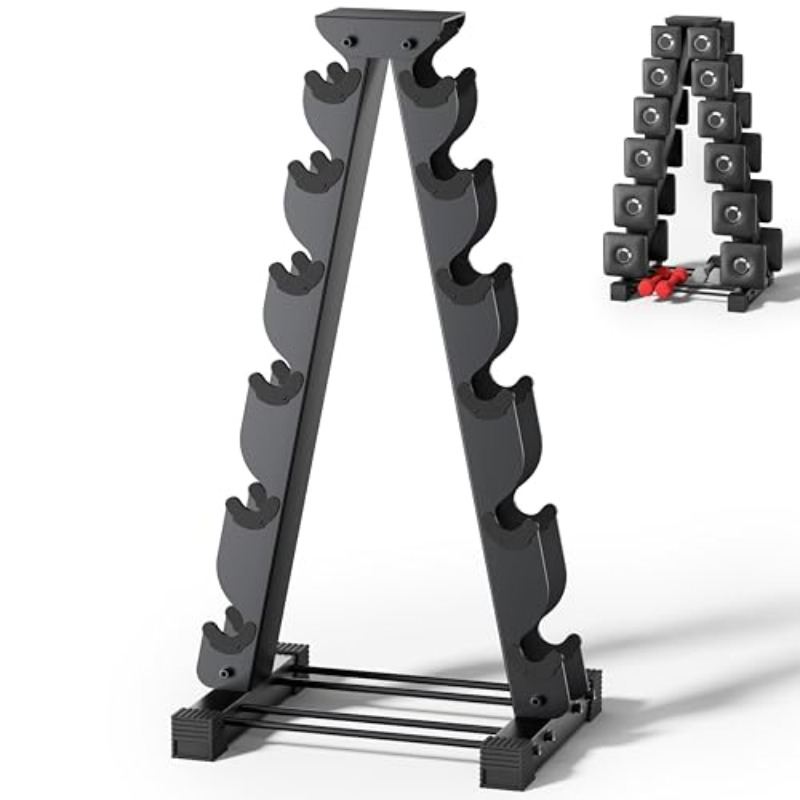
Well-organized gyms keep dumbbells racked in order — return yours to the right spot and you will always find the pair you need. It is a small habit that keeps the whole floor working smoothly.
Safety Notes
- Learn each machine's safety features before loading weight: pins, safety bars, and emergency stops exist for a reason.
- Never use a barbell bench press or squat without safety bars or a spotter once the weight gets challenging.
- Keep your back neutral (not rounded, not over-arched) on deadlifts, rows, and squats. When in doubt, lower the weight.
- Eat something with carbohydrates and protein within a couple of hours before training — training fasted and dizzy helps no one.
- If you are pregnant, postpartum, or managing a medical condition or injury, get clearance and preferably a few sessions with a qualified trainer who understands your situation.
If you are weighing whether to keep the gym membership or train at home long-term, our home gym vs. gym membership cost breakdown lays out the real numbers.
FAQ
Q: How long should a beginner gym session take?
About 45–60 minutes including warm-up and cool-down. Longer is not better at this stage — focused sets beat marathon sessions.
Q: I am a woman — will lifting weights make me bulky?
No. Building significant muscle mass takes years of dedicated heavy training, a caloric surplus, and usually a hormonal profile most women do not have. Strength training gives women firmer muscles, stronger bones, better posture, and a healthier metabolism. The "bulky" fear keeps too many women from the most effective training there is.
Q: Should I do cardio too?
Two to three easy cardio sessions (20–30 minute walks, bike rides, or incline treadmill) per week complement this plan nicely. Do them on non-lifting days or after lifting, not before — pre-fatigued legs make for sloppy squats.
Q: What if I miss a session?
Just do the next one. Do not double up, do not "make up" the missed workout, and do not restart the month. Consistency over months matters; any single week does not.
Q: When do I stop being a "beginner"?
Roughly when you can no longer add weight every session or two and need more complex programming to progress — typically 3–6 months of consistent training. There is no ceremony; you will simply notice the easy gains slowing, which is the signal to move to an intermediate program.
Q: Do I need a personal trainer?
Not mandatory, but 2–3 sessions with a good trainer early on can shortcut months of form guesswork — especially for squats, deadlifts, and presses. Choose one who asks about your goals and injury history rather than selling packages.
Conclusion
Your first month at the gym is not about impressive weights — it is about learning seven movements, showing up three times a week, and adding the smallest possible weight whenever your form earns it. Machines first, then free weights. Form first, then load. Habit first, then everything else. Do that for four weeks and you will walk into month two not as a nervous newcomer but as someone who belongs there — because you will have earned it, one session at a time.