Searching for the best massage gun for muscle recovery? We compared five models on power, noise, attachments and price — including a clever reach-belt design.
Best Massage Gun for Muscle Recovery: 5 Picks From $12 to Pro Level
There's a specific moment when a massage gun stops being a gadget and becomes part of your routine: the morning after leg day, when the stairs look like a personal insult. Percussion therapy has earned its place in home recovery because it does something foam rollers struggle with — it reaches deep, specific spots quickly, without you having to contort yourself on the floor. If you're hunting for the best massage gun for muscle recovery, the good news is that the technology has trickled down fast. The confusing news is that spec sheets are full of inflated numbers.
So here's how we'll do this: honest guidance on what actually matters (amplitude, stall force and noise — not the made-up RPM claims), then five real picks at five real price points, from a $12.65 starter to a belt design that solves the one problem every massage gun owner knows: your own back.
This guide contains affiliate links. If you buy through them, VÉLORA may earn a commission at no extra cost to you.
What Actually Matters in a Massage Gun
Amplitude: the number that decides "deep tissue"
Amplitude is how far the head travels with each hit, measured in millimeters. Around 8mm feels like a vigorous surface massage. The 10–12mm range is where genuine deep-tissue work happens — the percussions reach into glutes, quads and upper back properly. If a listing hides its amplitude and shouts about speed instead, that's a tell.
Stall force: power you can actually use
Stall force is how hard you can press before the motor gives up. Light-pressure devices stall the moment you lean into a tight glute, which makes them useless for the exact job you bought them for. You don't need professional-grade force for home use, but a gun that maintains its rhythm under moderate pressure is non-negotiable for larger muscle groups.
Noise: the underrated spec
Here's the thing nobody mentions until it's too late: a loud massage gun doesn't get used. If it sounds like a power drill, you won't touch it during a quiet evening, in a shared flat, or while watching something. Quieter brushless motors are worth paying a little more for, especially if recovery time doubles as wind-down time.
Attachments and battery
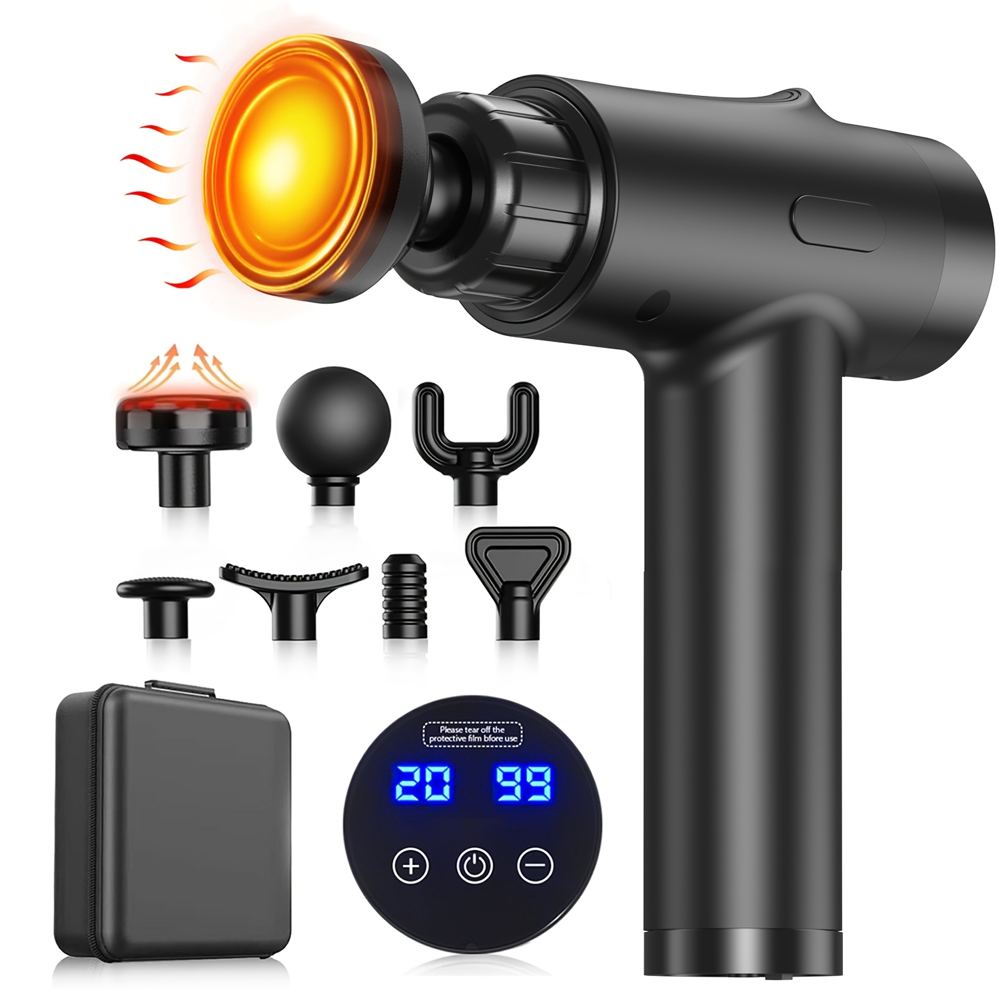
Four to six heads cover everything: a round head for big muscles, flat for broad areas, a fork for the spine-adjacent muscles and Achilles, and a bullet for deep knots and feet. Battery life of two-plus hours per charge is plenty; what matters more is honest battery claims and a standard charging cable you won't lose.
The Best Massage Guns for Muscle Recovery
Massage Gun Deep Tissue Full Body Back Massager — the budget starter
At $12.65, this is the "find out if percussion therapy works for you" gun, and honestly, for a lot of people it's enough. It covers the basics — deep tissue percussion for the back and full body, multiple heads, a compact body — at a price where there's almost no buyer's remorse possible.
Set expectations fairly: budget guns have smaller amplitude and will stall if you really lean in, and the battery and motor aren't built for a decade of daily use. But as a first massage gun, or a second one that lives in a gym bag, it makes a genuinely sensible case.
Pros
- Just $12.65 — the lowest-risk way to try percussion therapy
- Full-body design with the essential attachment heads
- Compact and light for travel or gym-bag duty
Cons
- Stalls under heavy pressure on large muscles
- Shorter motor and battery lifespan than pricier models
Price: $12.65
View on VÉLORA
Deep Tissue Massage Gun, Portable & Quiet — the everyday sweet spot
This is where we'd point most home users. The pitch is right in the name: proper deep-tissue percussion, multiple attachments, and a motor tuned to stay quiet — the combination that turns a massage gun into a nightly habit instead of a novelty. It's portable enough for a drawer or tote, and the head set covers quads, glutes, calves, shoulders and feet without improvising.
At $20.75 it sits in the value sweet spot of the whole category: meaningfully better motor manners than the budget tier, without paying for professional branding. If you train three to five times a week and want one gun that just works, this is the sensible default.
Pros
- Quiet motor you'll actually use in the evening
- Multiple attachments for full-body coverage
- Excellent price-to-performance balance
Cons
- Not the highest stall force for very heavy pressure work
- Case and finish are functional rather than premium
Price: $20.75
View on VÉLORA
Athlete Massage Gun Deep Tissue Portable Electric — the power pick
Built for people who train hard and recover like it matters, this $33.05 model steps up motor strength and amplitude for genuine deep work on dense muscle — glutes after heavy hip thrusts, quads after a long run, upper back after desk-plus-deadlift days. The portable electric design keeps it cordless and manageable, but the emphasis here is clearly force over finesse.
If your muscles are smaller or you're sensitive to intense percussion, this may be more gun than you need — its lowest settings still mean business. For regular heavy trainers, though, it's the pick that won't stall when you press into a stubborn knot.
Pros
- Strongest percussion here for dense, hard-worked muscle
- Maintains power under pressure without stalling
- Built for frequent, serious training schedules
Cons
- Can feel intense for beginners or sensitive users
- Slightly heavier in hand during long sessions
Price: $33.05
View on VÉLORA
2-in-1 Electric Massage Gun Reach Belt — the back-solver
Every massage gun owner knows the geometry problem: the tightest spot is always between your shoulder blades, exactly where your arm can't press a gun properly. This clever 2-in-1 design adds a reach belt, letting you position the percussion against your mid and lower back, hold the handles, and control pressure with your body instead of your shoulder mobility.
At $38.73 it's the priciest here, and the gun itself is a solid mid-range unit — but you're paying for the one feature nobody else in this list offers. For desk workers with chronic mid-back tightness, it's not a gimmick at all. It's the difference between treating the spot and treating everything around the spot.
Pros
- Reach belt design finally solves mid and lower back access
- Controlled pressure using body weight, not arm strength
- Doubles as a conventional handheld massage gun
Cons
- Most expensive pick in this guide
- Belt setup takes a moment longer than grab-and-go use
Price: $38.73
View on VÉLORA
5-in-1 Electric Massage Gun, 6 Speeds — the Daraz value pick
For our readers shopping on Daraz, this 5-in-1 model at Rs 1,900 is the local value standout. Six speeds give you a proper range — gentle flushes for rest days, deeper settings after hard sessions — and the five attachments cover the standard map of sore spots. Six speeds also matters more than it sounds: recovery work should start gentle and build, and cheap two-speed guns skip that nuance entirely.
As with most budget listings, treat the marketing numbers with a pinch of salt and lean on the fundamentals: multiple heads, graded speeds and a price that makes it an easy yes. For the money, it's a lot of recovery.
Pros
- Rs 1,900 — outstanding local value
- 6 speeds for proper gentle-to-deep progression
- 5 attachments included
Cons
- Budget build; amplitude is modest
- Battery life is fine, not class-leading
Price: Rs 1,900
View on VÉLORA
How to Use a Massage Gun Without Annoying Your Muscles
A few habits separate helpful recovery from random buzzing. Float the gun over the muscle and let it do the work — pressing harder isn't always better. Spend 30–60 seconds per spot, move slowly (about an inch per second), and keep sessions around 10 minutes total. Avoid bones, joints and the front of the neck entirely. Post-workout, use it within a couple of hours for the best feel; on rest days, a gentle low-speed session pairs beautifully with stretching. If your home setup values quiet above all, you'll also enjoy our guide to quiet home gym equipment for apartments.
Frequently Asked Questions
Do massage guns actually help muscle recovery?
Evidence and athlete experience both point the same way: percussion therapy increases local blood flow, temporarily improves range of motion and reduces perceived soreness. It won't replace sleep, protein or sensible programming — but as a daily recovery habit, it genuinely helps most people feel ready to train again sooner.
How long should I use a massage gun after a workout?
About 10 minutes total is plenty. Give each major muscle group 30–60 seconds of slow passes, with up to two minutes on a genuinely tight spot. More isn't better — overworking one area can leave it feeling bruised.
What's the difference between cheap and expensive massage guns?
Mainly amplitude, stall force, noise and longevity. Expensive guns hit deeper, keep their rhythm under pressure, run quieter and last longer. Budget guns are fine for light use and smaller muscles, which is why we rate the $12.65 and Rs 1,900 picks as smart starters rather than false economies.
Can I use a massage gun every day?
Yes, daily use at moderate settings is fine for most healthy people. Keep pressure comfortable, skip any spot that feels sharper rather than better, and avoid using it over injuries, bruises or irritated skin. If pain persists beyond normal soreness, that's a physiotherapist conversation, not a massage gun problem.
Which attachment head should I use where?
Round head for large muscles like quads and glutes. Flat head for broad, dense areas like the chest and back. Fork head for either side of the spine and the Achilles — never directly on the spine itself. Bullet head for deep, specific knots and the soles of the feet, used briefly and gently.
The Bottom Line
On a tight budget, start with the $12.65 gun or the Rs 1,900 Daraz pick and learn what percussion does for you. For most home trainers, the quiet $20.75 model is the one that becomes a daily habit. Heavy lifters should step up to the Athlete gun, and anyone whose back is the whole problem should look seriously at the reach belt.
Explore the full range on the muscle recovery category page, and for the training side of the equation, see our picks for quiet home gym equipment for apartments.